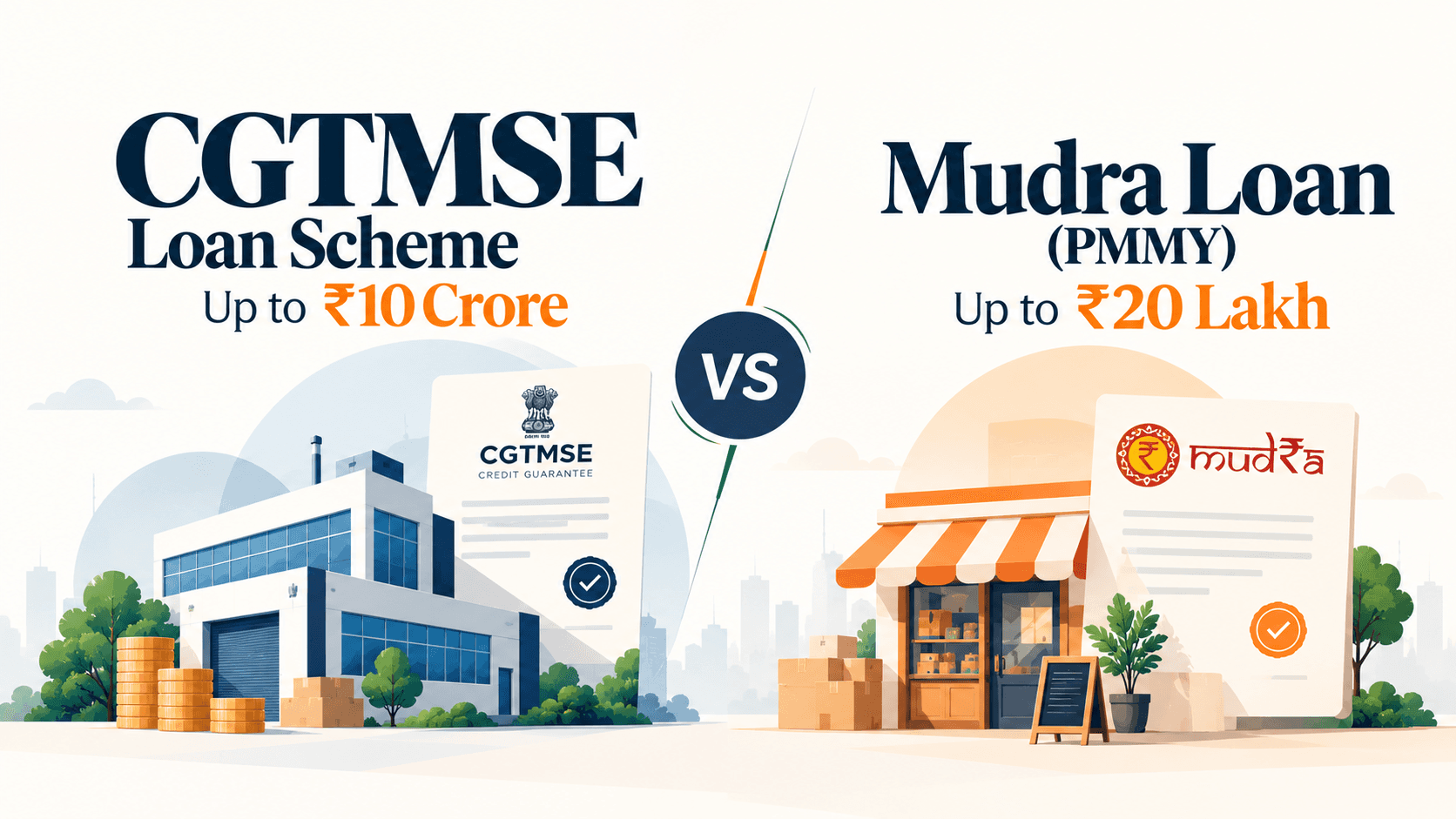
When searching for a collateral-free business loan in India, almost every entrepreneur encounters two flagship government-backed names: the Mudra Loan (under the Pradhan Mantri MUDRA Yojana - PMMY) and the CGTMSE Loan (backed by the Credit Guarantee Fund Trust for Micro and Small Enterprises). While both eliminate the need to pledge residential or commercial property as collateral, they are designed for fundamentally different stages of business maturity and ticket sizes.
Understanding India's Collateral-Free MSME Credit Ladder in 2026
As highlighted in recent 2026 MSME lending analyses, policy upgrades have doubled the ceiling at both ends of the ladder: PMMY now stretches up to ₹20 Lakh via the Tarun Plus category, while CGTMSE now guarantees credit facilities up to ₹10 Crore per borrower. Choosing the wrong scheme — or applying for a ₹50 Lakh facility under a micro-credit framework — leads to avoidable bank rejections and wasted months.
What Is a Mudra Loan (PMMY)? Shishu, Kishore, Tarun & Tarun Plus
Launched in 2015 under Micro Units Development and Refinance Agency Ltd. (MUDRA, a subsidiary of SIDBI), Pradhan Mantri MUDRA Yojana (PMMY) is a branded micro-credit programme designed to bring non-corporate, non-farm micro units — such as small shopkeepers, traders, artisans, food processors, service vendors and light manufacturing units — into formal institutional banking.
In 2026, Mudra loans are structured across four distinct growth tiers and backed primarily by portfolio guarantee cover under the Credit Guarantee Fund for Micro Units (CGFMU) managed by the National Credit Guarantee Trustee Company (NCGTC):
| Category | Loan amount | Designed for |
|---|---|---|
| Shishu | Up to ₹50,000 | Micro-starters, street vendors and nano-entrepreneurs purchasing basic tools or initial inventory. Zero processing fee at public sector banks. |
| Kishore | Above ₹50,000 up to ₹5 Lakh | Established micro-retailers, repair workshops and small service providers expanding working capital or purchasing commercial equipment. |
| Tarun | Above ₹5 Lakh up to ₹10 Lakh | Growing micro enterprises with verifiable tax returns and bank turnover seeking machinery or working capital expansion. |
| Tarun Plus | Above ₹10 Lakh up to ₹20 Lakh | Entrepreneurs who have previously availed and successfully repaid a loan under the Tarun category. |
What Is a CGTMSE Loan? Institutional Credit Up to ₹10 Crore
Unlike Mudra — which is a defined micro-loan product band capped at ₹20 Lakh — CGTMSE is a comprehensive institutional credit guarantee mechanism covering term loans and working capital facilities (Cash Credit, Overdraft and composite limits) from ₹10 Lakh up to ₹10 Crore (and even sub-₹10 Lakh micro loans where banks opt for individual CGTMSE cover rather than CGFMU).
Under CGTMSE, any Udyam-registered Micro or Small Enterprise — including Private Limited Companies, LLPs, partnerships and proprietorships — can approach a Member Lending Institution for substantial capex or working capital. The bank underwrites the proposal using formal financial ratios (DSCR, Current Ratio, TOL/TNW) and secures 75% to 85% (up to 90% for women in select categories) guarantee coverage from the Trust at an Annual Guarantee Fee between 0.37% and 1.20% p.a. For the full breakdown, read our CGTMSE Loan Scheme 2026 guide.
CGTMSE vs Mudra Loan: The Comprehensive 2026 Comparison
When evaluating CGTMSE vs Mudra loan options, founders and CFOs should compare the two schemes across nine operational and regulatory dimensions:
| Comparison parameter | Mudra Loan (PMMY 2026) | CGTMSE Loan Scheme (CGS-I 2026) |
|---|---|---|
| Core nature of scheme | Branded micro-credit loan product offered in 4 tiers (Shishu, Kishore, Tarun, Tarun Plus). | Institutional credit guarantee mechanism backing bank/NBFC term loans and working capital. |
| Maximum loan limit | Up to ₹10 Lakh (standard); up to ₹20 Lakh under Tarun Plus (requires prior repaid Tarun loan). | Up to ₹10 Crore per eligible MSE borrower (raised from ₹5 Crore effective April 2025). |
| Eligible entities | Non-corporate micro units (Proprietorships, Partnerships, small traders, artisans, service units). | All Udyam-registered Micro & Small Enterprises (including Pvt Ltd, LLPs, Partnerships, Proprietorships). |
| Underlying guarantee trust | Covered under CGFMU (managed by NCGTC) at 75% of 97% of default amount (portfolio cap 15%). | Covered by CGTMSE (Ministry of MSME & SIDBI) at 75% to 85% (up to 90% for Women MSEs). |
| Annual guarantee fee | CGFMU Standard Basic Rate is 1.00% p.a. of sanctioned/outstanding micro loan (often bundled by lender). | 0.37% p.a. (up to ₹10L) scaling across 7 slabs to 1.20% p.a. (₹8 Cr–₹10 Cr), plus 10% concession for priority groups. |
| Collateral requirement | 100% collateral-free and zero third-party guarantee across all four tiers. | 100% collateral-free up to ₹10 Cr; also supports Hybrid Security (partial collateral + guarantee). |
| Typical interest rate | ~9.0% to 12.5% p.a. at PSU banks; higher (14%–22%) through NBFCs and MFIs. | MCLR / Repo-linked bank rates (~8.85% to 13.5% p.a. at PSU and leading private banks). |
| Credit facilities covered | Term loans, micro working capital overdrafts and Mudra RuPay debit card limits. | Term Loans, Cash Credit (CC), Overdraft (OD) and composite (Fund + Non-Fund LC/BG) limits. |
| Documentation & sanction time | Light KYC, Udyam certificate, basic quotation & 6–12m bank statements (sanction: 3–10 days). | Full DPR, CMA projections, 2–3 yrs audited financials, GST returns & CGPAN workflow (sanction: 2–5 weeks). |
Decision Matrix: Which Collateral-Free Loan Should Your Business Choose?
Selecting between Mudra vs CGTMSE comes down to four clear decision rules based on your funding quantum, legal constitution and financial track record:
Scenario A: Under ₹10 Lakh (new or thin-file micro business)
Choose a Mudra Loan (Shishu, Kishore or Tarun). Documentation is lightweight, processing fees are nil for Shishu/Kishore at public sector banks like SBI, and you do not need 3 years of audited balance sheets or complex CMA data.
Scenario B: ₹10 Lakh to ₹20 Lakh
If you have already availed and cleanly repaid a Tarun Mudra loan, apply for Mudra Tarun Plus for fast renewal. However, if you are a first-time borrower seeking ₹15 Lakh–₹20 Lakh — or if your business is incorporated as a Private Limited Company — apply for a CGTMSE-backed loan under the Special ≤₹20 Lakh Provision (which carries an 85% guarantee cover and a low 0.37%–0.45% AGF rate compared to CGFMU's 1.00% fee).
Scenario C: ₹20 Lakh to ₹10 Crore (scaling manufacturing, trade or services)
Mudra caps out strictly at ₹20 Lakh. Any collateral-free requirement above ₹20 Lakh must be structured under the CGTMSE Loan Scheme (or CGSS up to ₹20 Crore if you hold DPIIT Startup recognition).
Scenario D: High-ticket capex above ₹2 Crore with partial property security
Use CGTMSE Hybrid Security. Mudra does not support hybrid collateral structures, whereas CGTMSE allows you to pledge existing partial collateral and still cover up to ₹10 Crore of uncovered credit exposure.
Step-by-Step Capital Sequencing Strategy for Growing MSMEs
High-growth Indian businesses do not view Mudra and CGTMSE as mutually exclusive rivals; instead, they sequence them across a 3-stage institutional credit roadmap:
Years 0–1: Establish institutional credit history
Obtain free Udyam Registration, open a dedicated current account, and secure a ₹5 Lakh–₹10 Lakh Kishore or Tarun Mudra loan via the JanSamarth Portal. Route 100% of business sales through the bank account and pay EMIs on time for 12–18 months to build a strong CMR-1 to CMR-3 bureau score.
Years 2–3: Graduate to ₹20 Lakh–₹1 Crore working capital
Once your GST returns and audited financials reflect steady cash flows, either unlock the ₹20 Lakh Mudra Tarun Plus tier or transition your credit line into a CGTMSE-backed Cash Credit + Term Loan facility (₹25 Lakh to ₹1 Crore) at low 0.55%–0.60% annual guarantee fees.
Years 3+: Industrial scale up to ₹10 Crore
Obtain MSME ZED Certification to lock in a 10% fee discount and 85% coverage, prepare a multi-year CMA & Detailed Project Report, and scale your CGTMSE-backed working capital and machinery limits up to ₹10 Crore as turnover expands.
Common Borrower Misconceptions About Mudra & CGTMSE Loans
Myth: Mudra and CGTMSE provide free government subsidies.
Neither Mudra nor CGTMSE is a capital subsidy scheme. Both are commercial credit frameworks that eliminate collateral requirements via sovereign-backed guarantees. If you want an upfront capital subsidy (15% to 35% margin money subsidy) for a new manufacturing or service unit, evaluate the PMEGP (Prime Minister's Employment Generation Programme) scheme.
Myth: Any new borrower can directly claim ₹20 Lakh under Mudra.
The ₹10 Lakh to ₹20 Lakh Tarun Plus slab is strictly restricted to repeat borrowers who have previously taken and successfully closed a Tarun category loan (₹5 Lakh–₹10 Lakh). First-time borrowers needing ₹15 Lakh–₹20 Lakh must use CGTMSE.
Myth: Banks cannot reject a CGTMSE or Mudra application.
Guarantee coverage does not override commercial credit appraisal. Banks retain full discretion to reject proposals that lack cash-flow viability, show poor CIBIL/CMR scores, or have incomplete tax and GST trails.
Looking for a capital subsidy instead of a guarantee? See our PMEGP loan support.
Frequently Asked Questions
Can a Private Limited Company apply for both Mudra and CGTMSE loans?
No. Pradhan Mantri MUDRA Yojana (PMMY) is specifically restricted to non-corporate micro units (Proprietorships, Partnerships and informal micro enterprises). Private Limited Companies and corporate MSMEs must apply under the CGTMSE scheme (up to ₹10 Crore) or Startup India's CGSS (up to ₹20 Crore).
Which loan has a lower guarantee fee for a ₹10 Lakh credit facility — Mudra or CGTMSE?
Under the April 2025 revision, CGTMSE charges a standard Annual Guarantee Fee of just 0.37% p.a. for loans up to ₹10 Lakh (and 0.55% p.a. for ₹10 Lakh–₹50 Lakh), whereas the CGFMU portfolio guarantee backing Mudra loans carries a Standard Basic Rate of 1.00% p.a. However, for micro-tickets under ₹5 Lakh, Mudra offers faster sanctioning with minimal paperwork.
Can I hold an active Mudra loan and later apply for a CGTMSE loan?
Yes. Many businesses start with a Kishore or Tarun Mudra loan and subsequently either foreclose/take over that limit into a larger CGTMSE-backed Cash Credit facility or avail an additional CGTMSE term loan for new machinery, provided their overall cash flows and DSCR support the combined debt service.
How do I check if my business qualifies for CGTMSE vs Mudra before visiting a bank?
Verify that your Udyam Registration is active, pull your personal CIBIL and company CMR report, and match your required loan amount against your last 12 months of GST/bank turnover (banks typically sanction working capital up to 20%–25% of projected annual turnover). Working with an MSME advisory consultant ensures your CMA data and project report match the exact scheme underwriting norms.
Maximise your MSME loan approval chances with AarambhGrow
Not sure whether your enterprise should file under Mudra Tarun Plus, CGTMSE (up to ₹10 Crore) or PMEGP subsidy schemes? AarambhGrow helps startups and MSMEs across India evaluate scheme eligibility, structure bank-ready Detailed Project Reports (DPR) and CMA financials, obtain Udyam and ZED certifications, and coordinate directly with CGTMSE-enrolled banks.
Sources & legal note
This article is educational and should not be treated as a substitute for financial, legal or tax advice. Loan limits, guarantee fees, interest rates and lender policies can change, and no professional can guarantee loan sanction. Review the latest official guidelines and your lender's terms before applying.